The In Memoriam segment of this year’s Academy Award ceremonies lasted for 15 minutes. On a night when several winners’ speeches were cut short—the songwriting team behind “Golden” was interrupted mid-sentence by its own platinum-plated K-pop earworm—the producers opted to go long in honoring a series of fallen icons, resulting in some distended but spellbinding television. Billy Crystal eulogized his pal and collaborator Rob Reiner (who never won an Oscar of his own). Rachel McAdams waxed rhapsodic about her Family Stone co-star Diane Keaton. And then Barbra Streisand, who hadn’t sung in public since 2019, serenaded the audience in honor of the late Robert Redford with the final verses of “The Way We Were,” sounding every bit of her 83 years in a good way. At that age, to paraphrase George Orwell, you have the voice you deserve.
“The Way We Were” was a predictable choice: Katie and Hubbell 4Ever. But beyond its obvious sentimental value, Streisand’s performance of an early-1970s standard signified something larger about a broadcast both steeped in nostalgia for what the Oscars used to mean and bristling with ambivalence about the shape of things to come. “I am Conan O’Brien, and I am honored to be the last human host of the Academy Awards,” deadpanned the evening’s emcee, whose entrance in Amy Madigan–Weapons costume set up an extended sight gag with plenty of subtext carried over from its suburban-Gothic source: a caricatured (and strangely ageless) avatar of the showbiz establishment being hunted and run down by a group of feral children.
O’Brien is a funny guy with nothing to prove; his hosting style reflects this fact, with the bonus that unlike, say, Jimmy Kimmel, Conan actually seems to like movies, and to have seen a few as well. His presence was more winning than his material, which was mostly kid-gloves stuff, with the punchiest jabs reserved for Netflix and its CEO, Ted Sarandos. (By not alluding to the impending Paramount+ merger, Conan left Nathan Fielder undefeated as the only comedian to equate new-media monopoly with incipient fascism.)
The angst of the opening extended through a series of live and recorded sketches, linked through their expressly technophobic subtext. One goofed on YouTube’s future as the event’s broadcaster while another affectionately travestied Casablanca as a piece of made-for-streaming slop, while another bit connected the Tik Tok–driven narrowing of on-screen aspect ratios to the narrowing of viewer attention spans, complete with an iPhoned-in cameo from Martin Scorsese. O’Brien’s “hostmaxxing” shtick also involved trying to transform a reaction shot of Leonardo DiCaprio into a meme in real time with caption “TFW You Didn’t Agree to This,” suggesting more than ever that Leo is morphing into a grand old(er) man, à la Jack Nicholson (or even Scorsese)—an emblem of The Movies who’ll have a front-row seat at these things as long as he keeps showing up. Meanwhile, Timothée Chalamet, duly cheap-shotted by O’Brien and others as an enemy of the high arts before losing best actor, may now have to hunt down an Oscar by any means necessary. How long until he puts in the call to Alejandro González Iñárritu? Or vice versa?
Chalamet’s
positioning as the evening’s big loser has a paging–Dr. Schadenfreude
quality in proportion to the actor’s perceived narcissism. Sitting in the front
with Kylie Jenner, the 30-year-old could have been a skinny effigy for Gen Z
itself. Because if there was anything at stake conceptually in this technically
clunky, tonally wonky Oscars show, it was the question of whether the kids
would be alright.
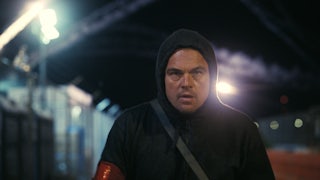
The vibes were old-fashioned on a night when the big winners were putatively progressive. Paul Thomas Anderson gave one acceptance speech after another—three in all, for writing, directing, and producing One Battle After Another, a worthier than usual best picture winner. But as he went on, he got further away from political commentary on behalf of a movie both praised and prodded for its political content, and into sentimentality and nostalgia. “I wrote [it] for my kids, to say sorry for the housekeeping mess that we left in this world we’re handing off to them,” the Studio City kid said after winning best adapted screenplay, leaving little ambiguity as to the meaning of OBAA’s coda, wherein Leonardo DiCaprio’s battle-weary bomber, Bob Ferguson, relaxes on the couch while his daughter Willa (Chase Infiniti) heads into the fray on his behalf. Anderson has tended to leave his movies open to interpretation, carving hairline fractures into their immaculate surfaces—and I’d preferred to think that the film’s final image of a revolutionary relaxing with a selfie complicated the movie’s own strange sense of complacency; that I still do is a case of trusting the tale and not the teller (or maybe playing favorites).
By the time PTA was in position to get the last word on the last year in cinema, accepting the best picture award, he opted to talk about the superlative best picture nominees of 1975: Jaws, Barry Lyndon, Dog Day Afternoon, Nashville, and One Flew Over the Cuckoo’s Nest, a murderer’s row of potentially deserving winners proffered as an example of how silly it is to split hairs over quality. His speech also played up the Way We Were in the ’70s—a decade Anderson has returned to, with fetishistic determination, time and again. Including, as it happens, in One Battle After Another, which superimposes certain modes and moods of the New Hollywood—including and especially its dalliances with radical chic—over a narrative set in a stealthily dystopian version of the twenty-first century. Anderson’s films often have clearly marked hinge moments, but One Battle After Another cultivates confusion about when it takes place; one hint that we’re in the present comes when Walk the Moon’s “Shut Up and Dance With Me” soundtracks high school dances. The movie’s middle-age girl dad’s heart, though, bleeds for Steely Dan and Tom Petty.
In the weeks leading up to the awards, commentators predictably positioned One Battle After Another and its fellow front-runner, Sinners, as rival heavyweights in a zeitgeist title fight: a symbolic sequel to the Moonlight–La La Land discourse wars of 2017. One way to read Ryan Coogler’s surprise early-summer blockbuster is as a cautionary tale about cultural appropriation: “We will make beautiful music together,” promises Jack O’Connell’s pale, assimilationist vampire before moving to feast on the patrons at an African American speakeasy. That fear of letting the wrong one in—or leeching off the lifeblood of others—mirrors critical skepticism around Anderson’s racialized reenvisioning of Thomas Pynchon’s Vineland, a novel without significant Black characters (Pynchon’s Frenesi Gate becomes the film’s Perfidia Beverly Hills). For every critic celebrating PTA’s willingness after a series of bespoke period pieces to square up to the present, there was another insisting his car-chase epic should have stayed more in its lane. But One Battle After Another and Sinners also have plenty in common: They’re both genre exercises caught in time warps of their own making.
Commercially savvy and stylistically sophisticated, Sinners also presented the possibility that Coogler could become the first Black filmmaker to win best director (a citation thus far denied to Spike Lee, Jordan Peele, and 2013 best picture helmer Steve McQueen). But Sinners had to settle (if that’s the word) for best cinematography (a landmark win for Autumn Cheyenne Durald Arkapaw, the first female recipient of that prize), best original screenplay (Coogler’s first Oscar, and likely not his last), best original score (Ludwig Göransson, looking like a refugee from a Joachim Trier movie), and best actor for Michael B. Jordan’s dual performance as fraternal entrepreneurs—one reckless, one cautious, and both projections of their writer-director-creator.
Like Anderson, Coogler played the proud-dad card in his speech, and doubled down giving Arkapaw’s son, Aidan, a piggyback down the aisle during hers so that the kid could watch his mom make history. Jessie Buckley, tapped as best actress for Hamnet, invoked the “beautiful chaos of a mother’s heart,” a line that would have worked equally well for her category rival, Rose Byrne, in the maternal rampage of If I Had Legs I’d Kick You (Byrne should have won, and might yet have to dress up in bark-cloth frocks à la Hamnet to one day make that happen).
The absurdity of the stylistically anodyne, aggressively middlebrow Sentimental Value—a movie with worse Netflix jokes than Conan’s—winning best international feature film over two scabrous, politically pressurized masterpieces (Jafar Panahi’s It Was Just an Accident and Kleber Mendonça Filho’s The Secret Agent) was mitigated by Joachim Trier’s observation, via a name-check of James Baldwin, that “all adults are responsible for all children.” Backstage, Trier clarified his remarks by citing the suffering of children in Palestine, Ukraine, and Sudan; his speech was not as confrontational as his category presenter Javier Bardem’s straight-up statement, “Free Palestine,” but conveyed more gravitas than PTA’s (tongue-in-cheek) postmortem query: “Aren’t we supposed to be partying?”
Well: Are we, or aren’t we? There are, as ever, two ways to look at the superfluousness of the Oscars: as a welcome distraction (for those in the position to welcome it) or a decadent and incestuous spectacle of self-congratulation. How much daylight really shows between these designations has always been hard to say, but it’s telling that last year’s broadcast did exponentially more to address (and visualize) the fact of Hollywood being on fire than this year’s did Tehran; the indelible-slash-despicable image, circulated on social media before the broadcast, of Kevin “Mr. Wonderful” O’Leary jockeying for red-carpet space with Panahi was one of those screen grabs worth a thousand words (including a few incredulous expletives). It Was Just an Accident is a psychodrama about the physical and psychic scars of state repression; a couple of weeks ago on The Daily Show, Panahi—who is heading back to Iran after the Oscars—said that his homeland “didn’t need Trump” (or his mandate of regime change) to navigate its ongoing authoritarian crisis.
For me, the face of the great Iranian actor Homayoun Ershadi early on during the In Memoriam montage served as a reminder on two fronts: of his extraordinary performance in Abbas Kiarostami’s The Taste of Cherry (1997) and of the dissonance that still exists between the Academy’s idea of moviemaking and the sort of cinema that exists beyond its membership. (Ershadi did appear in one best picture nominee: Kathryn Bigelow’s 2013 film Zero Dark Thirty, a war on terror thriller more rhetorically about the smell of napalm in the morning than the taste of cherry). The suggestion, proffered sincerely at the time, that Bong Joon-ho’s culturally specific, globally appealing class-war comedy Parasite (2019) might be the film to bridge that divide feels—as do so many other events from early 2020—like an incepted memory or a phantom thread, a fragile, febrile link to the Way We Were.
That’s too much to expect of any one movie, of course, just as it is too much to hope that any one awards show and its participants can reconcile the tensions between art and commerce—and also between competition and collegiality; activist urgency and black-tie decorum; and, above all, the tactile, problem-solving realities of film as craft and practice with the commentariat’s view of movies as airtight containers for ideology. There’s always next year; like Bob Ferguson, we’ll all be there, on the couch, on our phones.